
How URL shortening works comes down to one simple idea: a short link stores a destination, then sends the click there fast. For marketing agencies and influencers, that makes links easier to share, track, and brand.
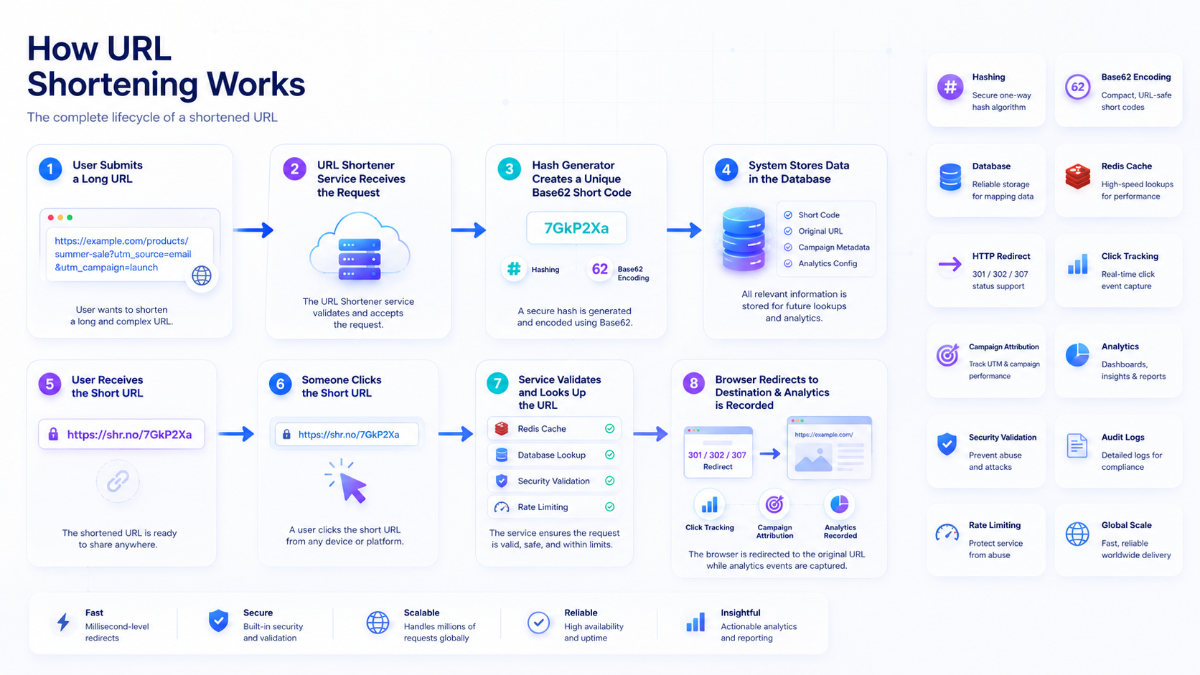
If you want a broader primer on use cases and best practices, see our guide to URL shortener use. For product context, Shrno and Commenda show how short links fit into a practical stack.
How URL Shortening Works: The Basics of URL Redirection
A short link is not magic. It is a redirect service. The short URL points to a record in a database. That record holds the long URL and any tracking data.
When someone clicks the short link, the service looks up the code and returns an HTTP redirect. Common choices are 301 for permanent moves and 302 or 307 for temporary routing. The MDN HTTP redirection guide explains the differences clearly, and the HTTP Semantics standard defines the status codes.
For most campaigns, the service uses a temporary redirect. That keeps analytics flexible. It also avoids telling browsers to cache the destination forever.
Understanding URL Shortening Algorithms
Most systems create short codes in one of three ways. Each method trades speed, size, and predictability in a different way.
- Sequential IDs: easy to build, but easy to guess.
- Hash-based codes: compact, but collision checks matter.
- Random base62 codes: harder to guess, and common in production.
Base62 uses 0-9, a-z, and A-Z. That gives more values per character than decimal. In practice, a 7-character code can represent far more links than a 7-digit number. This is one reason how URL shortening works at scale.
Well-built systems also reserve code space for branded paths, campaign tags, and retry logic. If a generated code already exists, the service tries again. In high-volume systems, that check must be fast.
How URL Shorteners Manage Large Volumes of Data
The hard part is not creating one short link. It is serving millions of clicks with low delay. Modern shorteners usually split the job across several layers.
A common pattern is write-once, read-many. New links go into primary storage. Click traffic then reads from a cache first, often Redis or a similar key-value store. That cuts database load and speeds up redirects.
At the storage layer, teams often use sharding or partitioning by code prefix or account ID. That keeps hot data from piling into one table. For analytics, event streams move click logs into a warehouse after the redirect finishes.
This design matters for marketers. A launch post from an influencer can drive a sudden spike. A good shortener keeps the redirect fast even when traffic jumps.
For a broader SEO context, the Google Search Central overview of how search works is useful when you think about crawl paths, while the AWS guide to database sharding explains one common scaling model.
Security Measures in URL Shortening
Short links can hide bad destinations, so security matters. A safe system checks for abuse before and after creation.
Good controls include destination scanning, domain reputation checks, rate limits, and link expiration. Many platforms also block private-network targets, such as 169.254.169.254, to reduce server-side request forgery risk.
A trusted shortener should also log every change. If a campaign link is edited, the system should record who changed it and when. That audit trail helps teams catch misuse fast.
For secure link handling, the OWASP URL Validation Cheat Sheet is a strong reference. For redirect behavior in the browser, the MDN 302 status code docs are also useful.
Case Study: Shrno's URL Shortening Process
Shrno is a good fit for teams that need short links with clear campaign control. A typical flow is simple. A user pastes a long URL, adds a campaign label, and creates a branded short link.
Behind the scenes, Shrno stores the destination, creates a compact code, and serves a redirect when the link is clicked. It can also attach tracking fields for channel, creator, or ad set.
That matters for agencies. One client may need clean links for paid social. Another may need separate short links for TikTok, email, and bio pages. Shrno keeps those paths distinct without adding friction.
A useful way to think about how URL shortening works in Shrno is this: creation is optimized for control, while click handling is optimized for speed.
What Good URL Shortening Looks Like in Practice
The best systems do five things well.
- Redirect in one hop.
- Keep codes short and hard to guess.
- Cache lookups for speed.
- Block unsafe destinations.
- Track clicks without slowing the user.
That is the practical answer to how URL shortening works. It is a small service with a simple public face, but the backend needs careful design.
Frequently Asked Questions