Why safe shortened URLs matter more than you think
Short links are common in engineering work. Safe shortened URLs are now part of your attack surface. If you run your own shortener or use a third-party service, treat it as production infrastructure. It is not just a convenience tool.
A compromised shortener can hide phishing pages. It can swap destinations or collect user data. It can also break marketing analytics, feature flags, or deep links your apps use. The good news is that the fixes are clear. Most are low effort if you plan them early.
This guide covers common risks, HTTPS and TLS setup, logging and monitoring, user data protection, and tools that help you keep safe shortened URLs under control in real systems.
Common security risks with shortened URLs
Shortened URLs add a layer users cannot see. That makes them useful, but it also hides risk. Most problems fall into a few clear buckets.
- Phishing and malware links that look harmless at first glance.
- Destination swaps when an attacker gains write access to the shortener.
- Brute force guessing of short codes that reveals internal links or campaigns.
- Open redirects that let attackers chain your domain into more complex attacks.
- Over-collection of click data without consent, which creates privacy and compliance issues.
If your shortener lives on a trusted domain, users often assume it is safe. That trust raises the impact of any misuse. Attackers know this, and they use compromised shorteners to raise click-through on malicious links.
Several security teams have warned that short links are a common phishing tool. The US Cybersecurity and Infrastructure Security Agency says URL obfuscation is a core phishing tactic. Short links are one way to do that, in its guidance on phishing campaigns in the CISA resource library at cisa.gov.
Short code enumeration is another practical threat. If you use simple, sequential IDs, an attacker can scan thousands of codes per minute. They can find internal admin links, password reset flows, or test environments. Rate limits and code entropy are not nice-to-haves here. They are baseline controls for safe shortened URLs.
Implementing HTTPS for secure URL shortening
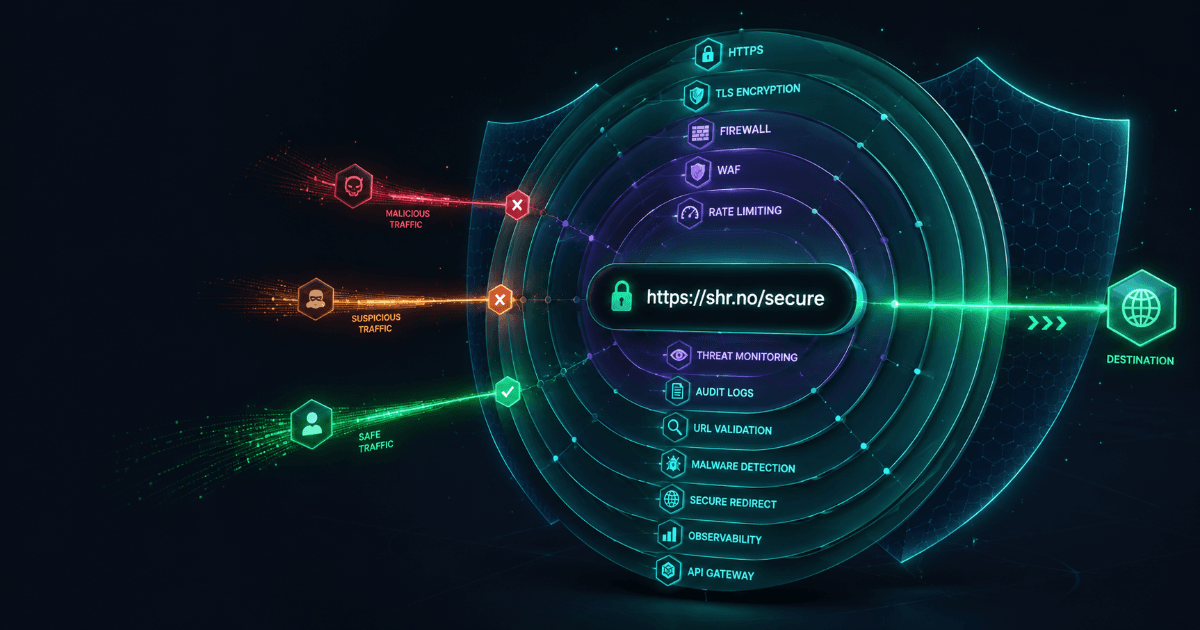
If your shortener still serves plain HTTP or mixed content, fix that first. Strong HTTPS is the base for safe shortened URLs. It helps with both user trust and modern browsers.
Follow the current RFC 9110 guidance on HTTP semantics and redirect status codes. Use 301 or 308 for permanent redirects and 302 or 307 for temporary ones. This may seem small, but analytics tools and crawlers use these signals to decide how to cache and rank your links.
On the transport side, aim for strong TLS settings. The Mozilla Server Side TLS guidelines give tested cipher suites and protocol settings for modern stacks. If you use Nginx or Envoy, you can almost copy their intermediate setup. It supports older Android users while staying secure.
Use automatic certificate renewal. Let’s Encrypt and ACME clients like certbot or lego make this easy and free. For example, a small team that runs a Go-based shortener behind Caddy can use Caddy’s built-in ACME support and never manage certificates by hand.
Finally, enforce HTTPS at the edge. Redirect all HTTP to HTTPS, set HSTS, and make sure your URL shortener never serves mixed content. This protects the first click and keeps your safe shortened URLs compatible with strict browser settings and security scanners.
Monitoring and managing shortened URL activity
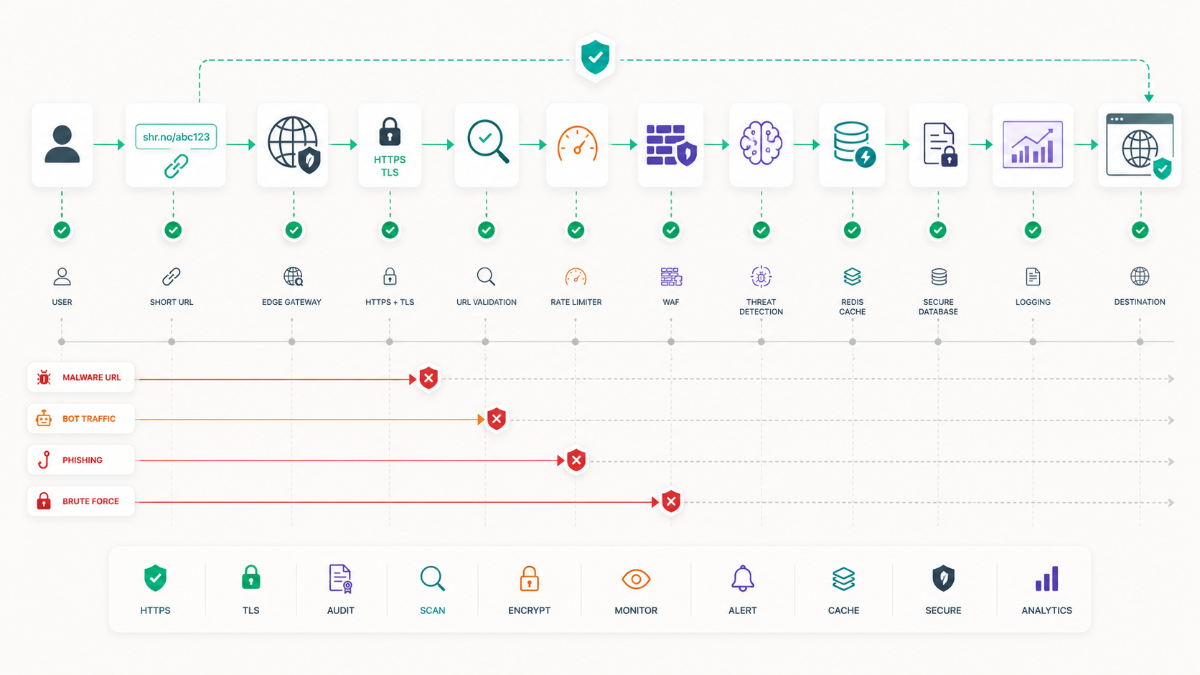
You cannot secure what you cannot see. A safe URL shortener needs good logs and simple ways to spot abuse early.
Start with structured logging for each click. At minimum, record a timestamp, the short code, resolved destination, HTTP status, and a coarse client ID such as IP hash and user agent. Use a fixed schema so you can ship these logs to Elasticsearch, OpenSearch, or a time-series database like VictoriaMetrics.
Add rate limits per IP, per code, and per user account. Tools such as Envoy or Nginx have built-in rate limiting that can sit in front of your shortener. This helps block brute force enumeration and basic denial-of-service attacks without code changes.
Modern observability stacks make this simpler. Many teams now send shortener logs to Prometheus for basic counters and Grafana Loki for event search. Then they build dashboards that show spikes in clicks, unexpected 4xx or 5xx rates, and new codes that get traffic from unusual regions.
For link health and safety, add regular scans. At larger scale, commercial link management systems use threat feeds and browser APIs to check destinations. You can mirror this by calling the Google Safe Browsing API, described in the official docs at developers.google.com, to flag links that load known phishing or malware pages.
If you want a managed solution instead of building everything yourself, products like Shrno give you short link creation, redirect control, and analytics with security-focused defaults. They help teams keep safe shortened URLs without adding yet another custom service to maintain.
Best practices for user data protection
Shorteners often collect rich click data. That data can be useful, but it can also be personal. Treat it like any other user analytics and align it with your privacy stance.
Start by avoiding unnecessary IDs. You rarely need a full IP address or a stable device fingerprint to run useful reports. Store only coarse location, hashed IP, and high-level device type where possible. That keeps your safe shortened URLs from becoming a shadow tracking system.
Follow the principle of data minimization from privacy frameworks such as the EU GDPR and similar laws. The European Data Protection Board explains this idea clearly in its guidance on anonymisation and pseudonymisation, published via the edpb.europa.eu site. In practice, it means collecting only the fields you need for agreed purposes and deleting them on a set schedule.
Encrypt data at rest in your shortener database. If you use cloud managed services, enable built-in encryption for Postgres, MySQL, or document stores. Restrict direct query access to a small set of accounts and run most analytics through prepared views or exports.
Finally, make consent and disclosure clear. If you use shortened URLs in emails or apps, link to a privacy notice that explains what data the shortener collects and how long you keep it. Engineering teams often partner with legal here, but the implementation details sit in your backlog.
Tools and patterns for URL shortening security
You can build a secure shortener from scratch, but most teams do better with a mix of existing tools and clear patterns. That keeps the focus on business logic instead of rebuilding link safety.
If you run a home-grown service, use battle-tested libraries for ID generation such as nanoid. It gives you short, random codes with high entropy and avoids predictable sequences. Combine this with per-code metadata that marks internal, external, and sensitive links. That lets you apply different policies.
From a platform view, reverse proxies and API gateways are key. Nginx, Envoy, or Traefik sit in front of many shorteners and handle TLS, logging, and rate limits. They also let you add security headers and centralize observability without touching the core redirect logic.
Managed platforms help when you want secure behavior by default. Commenda and Shrno are examples from the Nidavellirs ecosystem that aim to bundle link management, analytics, and safer redirect flows into one workflow. They fit into engineering stacks instead of sitting only in marketing.
For a broader view of how URL shorteners fit into a modern stack, the post The Ultimate Guide to URL Shortener Use: Benefits, Tools, and Best Practices covers product choices and general best practices. Read that with this article if you are designing a new shortener service or choosing a vendor.
Finally, keep an eye on current guidance from browser vendors and security bodies. The Google Chrome security blog at security.googleblog.com often shares changes in how browsers treat mixed content, redirects, and phishing signals. Aligning your shortener with those rules helps your safe shortened URLs work well for users and stand up to modern scanners.
Bringing it all together in your engineering roadmap
Many teams treat their shortener as a side project until it breaks. A better way is to plan a small set of work items. They move it toward a secure, observable service that produces safe shortened URLs by design.
- Audit current behavior for HTTPS, logging, and rate limits.
- Fix TLS and redirect codes based on modern guidance.
- Add basic abuse detection and link health checks.
- Review data collection and align it to your privacy stance.
- Decide whether to keep building or adopt a managed tool.
None of these steps require a rewrite. Most fit into a sprint or two. They also make it easier to prove to security and compliance teams that your shortener is safe and that your safe shortened URLs do not hide risky flows.
If your team already uses URL shorteners heavily, it is worth revisiting your architecture with security in mind. Pair this article with your internal threat models and with vendor guidance. Then adjust your stack before the next incident forces you to.
Frequently Asked Questions